AI Gave Everyone the Build Button. It Did Not Give Them Judgment.
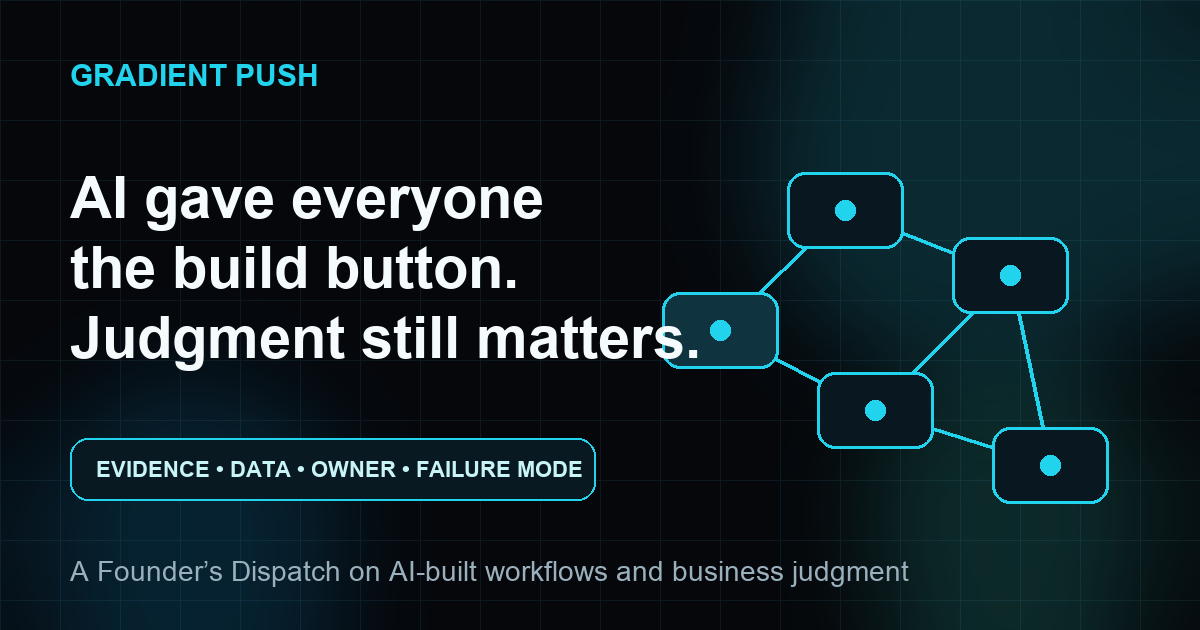
Before an AI-built workflow enters the business, check the evidence, data, system owner, failure mode, metric, and kill condition.
AI tools have made it much easier for non-engineering leaders to build something that looks real.
That is a real shift. A founder can prototype a customer workflow before the next product meeting. A CFO can mock a dashboard or reporting process without waiting on data capacity. A COO can wire together an internal automation. A chief of staff can turn a messy operating idea into a demo. A PM can sketch a feature path before engineering has time to engage.
This is useful. It makes vague ideas concrete. It shortens the distance between “we should try this” and “here is what we mean.” It can give technical teams a better starting point than a paragraph in a planning doc.
But access is not understanding.
That is where teams are going to get into trouble.
A generated workflow can make an idea feel further along than it is. A dashboard exists, so the decision system feels solved. An automation runs once, so the operating model feels designed. A demo lands well, so the roadmap or operating cadence absorbs it before anyone asks the harder questions: what system does this touch, what data moves, what breaks, who owns it, and whether the company actually needs it?
The problem is not leaders using AI. The problem is ungoverned build access being mistaken for judgment.
The old friction was annoying. It was also useful. Before these tools got good enough, a non-engineering operator usually had to translate an idea through people who understood constraints. Engineering asked where state lived. Data asked whether the source was trustworthy. Security asked what permissions were being granted. Ops asked who would maintain the workflow when the person who built it moved on.
That slowed things down. It also exposed assumptions.
Now more of that friction can be bypassed. A leader can make the artifact before the constraint conversation happens. Sometimes that is great. Sometimes it means a brittle idea shows up wearing the costume of a business system.
This is the distinction that matters: technical depth is not coding ability.
A CEO, CFO, COO, PM, or ops lead does not need to personally implement the production architecture. But they do need enough technical and operational taste to reason about constraints, tradeoffs, failure, maintenance, and organizational consequences. A workflow is not just a prompt and an output. It has system touchpoints, data boundaries, permissions, dependencies, exception paths, operating costs, and future owners.
If it works, someone has to maintain it. If it breaks, someone has to notice. If it touches customer data, financial reporting, internal approvals, or production workflows, someone has to be accountable for the blast radius.
AI can help produce the artifact. It cannot supply that reasoning for you. It can make the imagined path visible, but visibility is not judgment.
So I would not ban non-engineering leaders from building with AI. That would throw away the useful part. AI-built prototypes, dashboards, and workflows can be excellent discovery tools. They can sharpen ideas, reveal missing states, and help teams test whether a problem is real before scarce technical time gets spent.
But I would put a gate between “someone built this with AI” and “this enters the business.”
Not a committee. Not a six-week governance process. Just a short operator memo attached to the artifact.
Before an AI-built workflow enters the business, ask:
- What evidence justifies this: customer behavior, operator pain, financial need, support volume, usage data, or a real decision bottleneck?
- Which decision will it change: customer, product, financial, operational, staffing, compliance, or go-to-market?
- What existing system does it touch: product surface, CRM, billing system, warehouse, spreadsheet, admin tool, workflow, or third-party dependency?
- What data does it read or write: read-only context, customer state, account records, financial fields, permissions, messages, or automation triggers?
- What breaks if the generated workflow fails: bad customer action, wrong metric, exposed data, duplicate work, missed approval, broken permission, or support load?
- Who owns the architecture or operating decision: which technical, data, security, or ops owner agrees with the shape?
- Who maintains it after the demo: bugs, edge cases, documentation, permissions, analytics, dependencies, and process changes?
- What tradeoff did we knowingly accept: speed over completeness, manual review over automation, narrow integration over platform work?
- What metric would prove this is worth keeping: time saved, error reduction, cycle time, conversion, retention, margin impact, or support reduction?
- What is the kill condition: if the signal does not show up, when do we stop?
That memo changes the conversation. It turns the prototype from a persuasive object into a decision input.
It lets leaders keep the speed advantage without letting every generated artifact become organizational debt. It also gives technical teams something better to respond to. Instead of reacting to a shiny demo, the company can evaluate evidence, system impact, data risk, ownership, and tradeoffs.
That is the operating model I think more teams need: AI-assisted building as a discovery and operations lane, not a shadow roadmap.
The build button is powerful. It should be used.
AI removed some friction from making software-shaped things. Judgment decides which friction still belongs in the process.